Malignant Catarrhal Fever Symptoms in Beef
Cancerous Catarrhal Fever (MCF) is a viral disease mainly of ruminant animals such as
- cattle,
- bison,
- deer; and
- moose.
Information technology is usually fatal in highly susceptible species such every bit bison. Unlike bison, cattle are very resistant to the MCF virus. However, occasional cases in cattle do occur and, when they do, the event is usually fatal.
Causes
MCF is caused primarily by two different herpes viruses, one type which is found in wildebeest and a different type which is constitute in sheep. Although these animals can be carriers of the virus, they do not suffer from any ill effects. The wildebeest virus is rare in N America, since animals here exist only in zoos or exotic animal collections. The sheep-associated virus is very common in Northward America to such a degree that it is assumed that most sheep are carriers.
The virus ovine (sheep) herpesvirus-2 (OvHV-two)thou is shed in the nasal secretions of carrier sheep. It can be spread to bison through straight contact with carrier sheep; however, the virus also becomes aerosolized (airborne). Several studies take shown that bison with MCF practise not pass the virus on to other bison.
MCF in Bison
Symptoms
Bison may be found dead without symptoms, get ill and dice in vii to 10 days, or develop a chronic grade in which they are ill for months before they dice. Symptoms in bison sometimes are very subtle and may exist missed or misdiagnosed, equally bovine viral diarrhea virus (BVDV), respiratory virus, or a bacterial infection.
The post-obit are some of the most common symptoms:
- Depression – caput down, animal separates from herd, reduced or loss of ambition.
- Cloudy/ulcerated heart – slightly grey to totally white, may exist in one or both optics. In more extreme cases, the eye could burl or even rupture.
- Weeping middle – tearing from a slight scrap to two to iv inches of wet pilus under the eye.
- Snotty nose – watery discharge to white (milky) mucous strands from one or both nostrils (more astringent in cattle than in bison).
- Salivating – articulate watery mucus dripping from the mouth.
- Erosions/ulcers – pocket-sized sores or open lesions in the mouth which tin can extend into the throat and esophagus.
- Fever – up to 42.5 C, but the temperatures can vary over a wide range.
- Bloated joints – may be seen 10 to 12 days prior to onset of any other symptoms.
- Difficult urination – frequent, painful urination or bloody urine.
- Other symptoms – coughing, aborted fetus, aridity, diarrhea, tremors or circling.
Treatment
There is no effective treatment available for MCF in bison. Bison that become clinically ill will invariably dice.
Fourth dimension of year and surround
MCF tin occur any time throughout the year. Information technology appears to be more than prevalent during the winter months, which is when lambs come up of age (betwixt 6 to nine months). This group of sheep may shed more virus. It is also possible that the virus survives ameliorate in the cold winter season. Carrier sheep shed more than virus and bison are more susceptible during times of transportation, treatment, birth and weaning.
The virus tin can survive upward to 72 hours in the environment, only may survive up to 13 days if the surround is moist.
Prevention
Vaccine
There is no vaccine to prevent MCF in bison, nor is at that place a vaccine for the virus in sheep.
In full general, increasing the altitude betwixt sheep and bison reduces the risk. Information has changed in recent years as to the distance that should be kept between these animals. All the same, there is however no definitive science on what is considered a minimum safe distance This is because the risk of MCF varies depending on many factors besides altitude, such as the age of the sheep; the size of the flock; climate; wind; and temperature.
Bison producers are discouraged from establishing herds or pastures well-nigh sheep producers, and sheep producers are as well discouraged from establishing flocks or pastures near bison. Producers are urged to consider their proximity to other species, and to minimize opportunities for contact with the other species and their secretions particularly during times of transportation, handling, nascence and weaning.
Prevalence of OvHV-2 in the Canadian sheep flock
The prevalence of OvHV-2 in the Canadian sheep population is unknown. Studies conducted in the USA suggest that OvHV-2 may be very prevalent in North America.
An brute has MCF or has died of MCF?
If yous suspect your animal has MCF, contact your local veterinarian. Tests can be done on alive or expressionless animals to determine if they are infected with the virus. If the animal has been found dead without prior symptoms, information technology is important that other causes of sudden death, such as anthrax, are ruled out.
If MCF is found in your herd, your veterinarian can advise y'all on appropriate biosecurity measures you tin can take to minimize the potential for future incidents.
MCF in cattle
Cattle go infected with the virus through direct contact with carrier sheep or their secretions (i.e. contaminated feed bunks or water bowls). While the airborne virus tin can infect the highly susceptible bison, there is less of a run a risk for infection in cattle. Cattle are dead-end hosts; that is, cattle with MCF do not spread the virus to other animals.
MCF virus attacks the blood vessels in multiple organs so clinical signs tin be quite variable and may include sudden expiry, high fever, diarrhea (sometimes bloody), ocular (eye) and nasal discharge, or seizures. Decease can occur quickly, sometimes preceded by a short flow of depression, diarrhea and loss of appetite, but often with no other apparent symptoms. More apparent clinical signs are seen when animals survive longer. Animals with astute disease develop a loftier fever and cease eating. Cattle frequently take bilateral corneal opacity that begins at the outer edge of the eye and progresses inward.
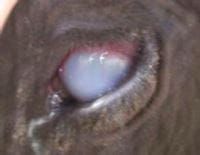
Fakri Fatima Zohra, WikiMedia
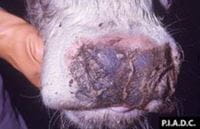
Credit: Plum Island Animate being Disease Centre
Watery discharge from the nose and optics is common early in the course of the disease; after, this belch becomes thick and cloudy. The cage and nostrils are commonly encrusted, and laboured animate and salivation may exist seen. The inside of the oral fissure is frequently reddened and with erosions and ulcers. The skin is sometimes reddened or ulcerated, and hardened scabs may develop. In some animals, the hoof may be loosened or slough off. The joints may be bloated, milk production oft drops, and the superficial lymph nodes are markedly enlarged. Diarrhea, with or without blood and claret in the urine can also be seen. Occasionally, animals have nervous signs including increased sensitivity to touch, incoordination, disorientation, tremors, rolling of the eyes or caput pressing.
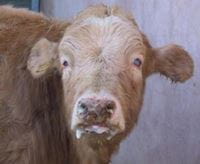
Photo Credit: National Animal Disease
Information Service, UK
Although many animals die of chronic infection (lasting weeks or months), recovery is possible. There is no vaccine and there is no treatment for this disease.
MCF tin can occur any time throughout the year. Information technology appears to be more than prevalent during the winter months, which is when lambs come of age (between half-dozen and nine months). This grouping of sheep sheds more virus. It is besides possible that the virus survives better in the cold winter season. Cattle are more susceptible during times of stress, such as transportation, handling, birth and weaning.
In Saskatchewan, MCF in cattle tends to occur infrequently. Only a few cases are confirmed past laboratory testing each yr. Without laboratory testing, cases may exist misdiagnosed as other, more than mutual cattle diseases such as Bovine Viral Diarrhea (BVD) or Infectious Bovine Rhinotracheitis (IBR). Therefore, confirming a diagnosis of MCF requires laboratory testing.
In most cases, cattle and sheep tin can be raised together without any issues provided a few bones guidelines are followed:
- Proceed young lambs (weaning up to 10-11 months of age) away from cattle;
- Practice not mix sheep and cattle during times of stress;
- Exercise not firm sheep and cattle together indoors; and
- Exercise non pen sheep and cattle together in crowded weather condition.
MCF Task Force study
The Saskatchewan Minister of Agriculture created this Job Force in response to concerns voiced by industry members in Saskatchewan over the potential risk of MCF occurring in bison as a event of exposure to sheep. View the Final Written report to the Saskatchewan Minister of Agriculture - December 2011.
jeffersonpand1948.blogspot.com
Source: https://www.saskatchewan.ca/business/agriculture-natural-resources-and-industry/agribusiness-farmers-and-ranchers/livestock/animal-health-and-welfare/malignant-catarrhal-fever#:~:text=Cattle%20are%20dead%2Dend%20hosts,and%20nasal%20discharge%2C%20or%20seizures.
0 Response to "Malignant Catarrhal Fever Symptoms in Beef"
Postar um comentário