What Is the Poverty Threshold for a Family of 4
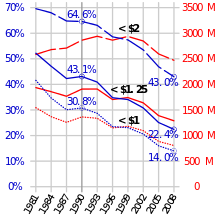
Graph of global population living on under 1, 1.25 and 2 equivalent of 2005 U.s. dollars daily (red) and as a proportion of world population (blue) based on 1981–2008 World Banking concern data
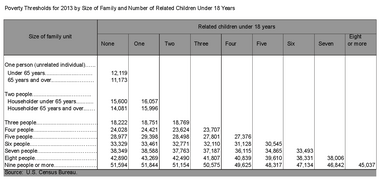
Poverty Thresholds for 2013
The poverty threshold, poverty limit, poverty line or breadline [1] is the minimum level of income deemed adequate in a particular country.[2] The poverty line is usually calculated past finding the full cost of all the essential resources that an average man adult consumes in one year.[iii] The largest of these expenses is typically the rent required for accommodation, so historically, economists have paid detail attention to the real estate market and housing prices equally a strong poverty line affect.[four] Private factors are often used to account for various circumstances, such as whether i is a parent, elderly, a child, married, etc. The poverty threshold may be adjusted annually. In practice, similar the definition of poverty, the official or common agreement of the poverty line is significantly higher in developed countries than in developing countries.[5] [6]
In Oct 2015, the Globe Bank updated the International Poverty Line (IPL), a global absolute minimum, to $i.90 per day[vii] (in PPP),[eight] where it current stands (as of 2022),[9] and as well as of 2022, $3.twenty per 24-hour interval in PPP for lower-heart income countries, and $v.50 per 24-hour interval in PPP for upper-centre income countries.[viii] [9] Per the $1.ninety/day standard, the percentage of the global population living in accented poverty fell from over fourscore% in 1800 to 10% past 2015, co-ordinate to United Nations estimates, which plant roughly 734 one thousand thousand people remained in absolute poverty.[10] [xi]
History [edit]
The poverty threshold was first developed past Mollie Orshansky between 1963 and 1964. She attributed the poverty threshold as a measure of income inadequacy past taking the cost of food programme per family of 3 or 4 and multiplying it by a cistron of 3. In 1969 the inter agency poverty level review commission adjusted the threshold for only price changes.[12]
Charles Booth, a pioneering investigator of poverty in London at the turn of the 20th century, popularised the idea of a poverty line, a concept originally conceived by the London School Board.[13] Booth set the line at 10 (50p) to 20 shillings (£1) per week, which he considered to be the minimum corporeality necessary for a family of iv or five people to subsist on.[14] Benjamin Seebohm Rowntree (1871–1954), a British sociological researcher, social reformer and industrialist, surveyed rich families in York, and drew a poverty line in terms of a minimum weekly sum of coin "necessary to enable families … to secure the necessaries of a healthy life", which included fuel and light, hire, food, clothing, and household and personal items. Based on information from leading nutritionists of the period, he calculated the cheapest price for the minimum calorific intake and nutritional balance necessary, before people get sick or lose weight. He considered this amount to set his poverty line and concluded that 27.84% of the total population of York lived beneath this poverty line.[15] This result corresponded with that from Booth's study of poverty in London and then challenged the view, commonly held at the time, that abject poverty was a problem particular to London and was not widespread in the remainder of Britain. Rowntree distinguished betwixt primary poverty, those lacking in income and secondary poverty, those who had enough income, only spent it elsewhere (1901:295–96).[15]
Absolute poverty and the International Poverty Line [edit]
The term "absolute poverty" is also sometimes used as a synonym for extreme poverty. Absolute poverty is the absenteeism of plenty resources to secure basic life necessities.
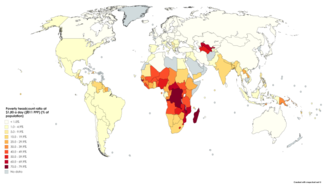
To help in measuring this, the World Bank has a daily per capita international poverty line (IPL), a global absolute minimum, of $1.90 a day as of Oct 2015.[17]
The new IPL replaces the $1.25 per day figure, which used 2005 information.[eighteen] In 2008, the Globe Banking company came out with a figure (revised largely due to aggrandizement) of $one.25 a 24-hour interval at 2005 purchasing ability parity (PPP).[nineteen] The new figure of $1.xc is based on ICP PPP calculations and represents the international equivalent of what $1.90 could buy in the US in 2011. Most scholars hold that it ameliorate reflects today's reality, especially new price levels in developing countries.[20] The common IPL has in the by been roughly $i a day.[21]
These figures are artificially low according to Peter Edward of Newcastle University. He believes the real number as of 2015 was $7.40 per day.[22]
Using a single budgetary poverty threshold is problematic when applied worldwide, due to the difficulty of comparison prices between countries.[ citation needed ] Prices of the same appurtenances vary dramatically from country to country; while this is typically corrected for by using PPP commutation rates, the basket of appurtenances used to determine such rates is ordinarily unrepresentative of the poor, nigh of whose expenditure is on basic foodstuffs rather than the relatively luxurious items (washing machines, air travel, healthcare) often included in PPP baskets. The economist Robert C. Allen has attempted to solve this by using standardized baskets of goods typical of those bought by the poor across countries and historical fourth dimension, for instance including a fixed calorific quantity of the cheapest local grain (such as corn, rice, or oats).[23]
Basic needs [edit]
The basic needs approach is one of the major approaches to the measurement of accented poverty in developing countries. It attempts to define the absolute minimum resources necessary for long-term concrete well-beingness, unremarkably in terms of consumption goods. The poverty line is and then defined equally the amount of income required to satisfy those needs. The 'basic needs' approach was introduced by the International Labour Organisation'southward Globe Employment Conference in 1976.[24] [25] "Perhaps the loftier bespeak of the WEP was the Globe Employment Conference of 1976, which proposed the satisfaction of basic human being needs every bit the overriding objective of national and international evolution policy. The basic needs arroyo to development was endorsed by governments and workers' and employers' organizations from all over the globe. Information technology influenced the programs and policies of major multilateral and bilateral development agencies, and was the precursor to the human development approach."[24] [25]
A traditional listing of immediate "basic needs" is food (including h2o), shelter, and clothing.[26] Many modern lists emphasize the minimum level of consumption of 'bones needs' of not just food, h2o, and shelter, only also sanitation, education, and wellness care. Unlike agencies use unlike lists. According to a United nations proclamation that resulted from the World Top on Social Evolution in Copenhagen in 1995, absolute poverty is "a status characterized by astringent deprivation of bones human needs, including nutrient, rubber drinking water, sanitation facilities, wellness, shelter, education, and information. It depends not only on income, but also on access to services."[27]
David Gordon's newspaper, "Indicators of Poverty and Hunger", for the United Nations, further defines accented poverty every bit the absence of whatsoever two of the post-obit eight basic needs:[27]

A homeless man seeks shelter under a public bench
- Nutrient: Body mass index must be above 16.
- Safe drinking water: Water must not come solely from rivers and ponds, and must exist available nearby (fewer than 15 minutes' walk each way).
- Sanitation facilities: Toilets or latrines must be accessible in or near the domicile.
- Health: Treatment must exist received for serious illnesses and pregnancy.
- Shelter: Homes must accept fewer than 4 people living in each room. Floors must not exist made of soil, mud, or clay.
- Educational activity: Anybody must attend schoolhouse or otherwise learn to read.
- Information: Everyone must accept admission to newspapers, radios, televisions, computers, or telephones at home.
- Access to services: This item is undefined past Gordon, but normally is used to indicate the complete panoply of pedagogy, health, legal, social, and financial (credit) services.
In 1978, Ghai investigated the literature that criticized the basic needs approach. Critics argued that the basic needs approach lacked scientific rigour; it was consumption-oriented and antigrowth. Some considered it to be "a recipe for perpetuating economic backwardness" and for giving the impression "that poverty elimination is all too easy".[28] Amartya Sen focused on 'capabilities' rather than consumption.
In the development discourse, the basic needs model focuses on the measurement of what is believed to exist an eradicable level of poverty.
Relative poverty [edit]
Relative poverty means depression income relative to others in a country:[29] for case, beneath 60% of the median income of people in that state.
Relative poverty measurements different accented poverty measurements take the social economic surround of the people observed into consideration. It is based on the assumption that whether a person is considered poor depends on her/his income share relative to the income shares of other people who are living in the aforementioned economy.[29] The threshold for relative poverty is considered to be at 50% of a country's median equivalised disposable income afterward social transfers. Thus, it can vary profoundly from country to country even after adjusting for purchasing ability standards (PPS).[30]
A person can be poor in a relative terms but not in absolute terms as the person might be able to meet her/his basic needs, simply not be able to relish the aforementioned standards of living that other people in the same economic system are enjoying.[31] Relative poverty is thus a form of social exclusion that tin can for example affect peoples access to decent housing, educational activity or job opportunities.[31]
The relative poverty mensurate is used by the United Nations Development Programme (UNDP), the United Nations Children's Fund (UNICEF), the Organization for Economic Co-operation and Evolution (OECD) and Canadian poverty researchers.[32] [33] [34] [35] [36] In the European Matrimony, the "relative poverty mensurate is the most prominent and most–quoted of the Eu social inclusion indicators."[37]
"Relative poverty reflects better the toll of social inclusion and equality of opportunity in a specific time and space."[38]
"One time economic evolution has progressed beyond a sure minimum level, the rub of the poverty problem – from the signal of view of both the poor individual and of the societies in which they live – is not and then much the effects of poverty in any accented form only the furnishings of the contrast, daily perceived, between the lives of the poor and the lives of those effectually them. For applied purposes, the problem of poverty in the industrialized nations today is a problem of relative poverty (page 9)."[38] [39]
Yet, some[ who? ] have argued that every bit relative poverty is merely a measure of inequality, using the term 'poverty' for information technology is misleading. For case, if everyone in a country'south income doubled, information technology would not reduce the amount of 'relative poverty' at all.
History of the concept of relative poverty [edit]
In 1776, Adam Smith argued that poverty is the disability to afford "not only the commodities which are indispensably necessary for the back up of life, but whatever the custom of the land renders it indecent for creditable people, even of the lowest club, to exist without."[twoscore] [41]
In 1958, John Kenneth Galbraith argued, "People are poverty stricken when their income, fifty-fifty if adequate for survival, falls markedly behind that of their community."[41] [42]
In 1964, in a joint commission economic President's study in the United states, Republicans endorsed the concept of relative poverty: "No objective definition of poverty exists. ... The definition varies from place to place and fourth dimension to time. In America as our standard of living rises, then does our thought of what is substandard."[41] [43]
In 1965, Rose Friedman argued for the utilise of relative poverty claiming that the definition of poverty changes with general living standards. Those labelled as poor in 1995, would have had "a higher standard of living than many labelled not poor" in 1965.[41] [44]
In 1967, American economist Victor Fuchs proposed that "we define as poor any family whose income is less than one-half the median family income."[45] This was the commencement introduction of the relative poverty rate as typically computed today [46] [47]
In 1979, British sociologist, Peter Townsend published his famous definition: "individuals... tin can exist said to exist in poverty when they lack the resource to obtain the types of diet, participate in the activities and accept the living atmospheric condition and civilities which are customary, or are at least widely encouraged or approved, in the societies to which they belong (page 31)."[48]
Brian Nolan and Christopher T. Whelan of the Economic and Social Research Found (ESRI) in Ireland explained that "poverty has to be seen in terms of the standard of living of the social club in question."[49]
Relative poverty measures are used as official poverty rates past the European Union, UNICEF and the OECD. The chief poverty line used in the OECD and the European Wedlock is based on "economic distance", a level of income set at sixty% of the median household income.[50]
Relative poverty compared with other standards [edit]
A measure of relative poverty defines "poverty" every bit being below some relative poverty threshold. For instance, the argument that "those individuals who are employed and whose household equivalised dispensable income is below 60% of national median equivalised income are poor" uses a relative mensurate to define poverty.[51]
The term relative poverty can as well be used in a different sense to mean "moderate poverty" – for example, a standard of living or level of income that is high plenty to satisfy basic needs (like water, food, clothing, housing, and bones health care), just still significantly lower than that of the bulk of the population nether consideration. An example of this could exist a person living in poor conditions or squalid housing in a high law-breaking area of a developed land and struggling to pay their bills every calendar month due to low wages, debt or unemployment. While this person nevertheless benefits from the infrastructure of the developed country, they still endure a less than ideal lifestyle compared to their more flush countrymen or even the more than flush individuals in less adult countries who have lower living costs.[52]
Living Income Concept [edit]
Living Income refers to the income needed to afford a decent standard of living in the place one lives. The distinguishing feature between a living income and the poverty line is the concept of decency, wherein people thrive, not simply survive. Based on years of stakeholder dialogue and good consultations, the Living Income Community of Do, an open learning community, established the formal definition of living income drawing on the piece of work of Richard and Martha Anker, who co-authored "Living Wages Around the Globe: Manual for Measurement". They define a living income as:[53]
The internet annual income required for a household in a particular place to beget a decent standard of living for all members of that household. Elements of a decent standard of living include nutrient, water, housing, pedagogy, healthcare, transport, clothing, and other essential needs including provision for unexpected events.
Similar the poverty line adding, using a single global monetary calculation for Living Income is problematic when applied worldwide.[54] Additionally, the Living Income should be adapted quarterly due to inflation and other significant changes such as currency adjustments.[53] The actual income or proxy income can be used when measuring the gap between initial income and the living income benchmarks. The World Bank notes that poverty and standard of living can be measured past social perception as well, and establish that in 2015, roughly i-third of the world's population was considered poor in relation to their particular society.[55]
The Living Income Community of Practice (LICOP) was founded by The Sustainable Food Lab, GIZ and ISEAL Alliance to measure the gap between what people around the world earn versus what they demand to have a decent standard of living, and observe ways to bridge this gap.[53]
A variation on the LICOP's Living Income is the Massachusetts Found of Technology'southward Living Wage Reckoner, which compares the local minimum wage to the corporeality of money needed to cover expenses across what is needed to merely survive across the United states of america.[56] The price of living varies profoundly if there are children or other dependents in the household.
Why poverty threshold matters [edit]
An outdated or flawed poverty measure out is an obstacle for policymakers, researchers and academics trying to find solutions to the problem of poverty. This has implications for people. The federal poverty line is used past dozens of federal, state, and local agencies, too as several individual organizations and charities, to make up one's mind who needs aid. The assistance can take many forms, but information technology is often hard to put in place any type of aid without measurements which provide data. In a rapidly evolving economic climate, poverty assessment often aids developed countries in determining the efficacy of their programs and guiding their development strategy. In addition, past measuring poverty i receives cognition of which poverty reduction strategies piece of work and which do not,[57] helping to evaluate unlike projects, policies and institutions. To a big extent, measuring the poor and having strategies to do so keep the poor on the calendar, making the trouble of political and moral business concern.
Threshold limitations [edit]
It is hard to have exact number for poverty, as much data is collected through interviews, meaning income that is reported to the interviewer must be taken at face value.[58] Every bit a issue, data could not rightly correspond the situations true nature, nor fully represent the income earned illegally. In addition, if the data were right and accurate, it would even so not mean serving every bit an adequate mensurate of the living standards, the well-being or economical position of a given family or household. Research washed past Haughton and Khandker[59] finds that in that location is no platonic measure of well-being, arguing that all measures of poverty are imperfect. That is non to say that measuring poverty should be avoided; rather, all indicators of poverty should be approached with caution, and questions about how they are formulated should exist raised.
As a result, depending on the indicator of economical status used, an guess of who is disadvantaged, which groups have the highest poverty rates, and the nation'south progress against poverty varies significantly. Hence, this tin can mean that defining poverty is not just a matter of measuring things accurately, but it too necessitates fundamental social judgments, many of which accept moral implications.
National poverty lines [edit]

2008 CIA Earth Factbook-based map showing the percentage of population by country living below that country's official poverty line
National estimates are based on population-weighted subgroup estimates from household surveys. Definitions of the poverty line exercise vary considerably among nations. For instance, rich nations generally employ more generous standards of poverty than poor nations. Even among rich nations, the standards differ greatly. Thus, the numbers are not comparable among countries. Fifty-fifty when nations practise use the same method, some issues may remain.[sixty]
United Kingdom [edit]
In the United kingdom of great britain and northern ireland in 2006, "more than than five million people – over a fifth (23 per centum) of all employees – were paid less than £6.67 an hour". This value is based on a depression pay rate of 60 percent of full-time median earnings, equivalent to a little over £12,000 a twelvemonth for a 35-hour working calendar week. In April 2006, a 35-hour week would take earned someone £nine,191 a year – before tax or National Insurance".[61] [62]
In 2019, the Low Pay Commission estimated that nigh 7% of people employed in the United kingdom were earning at or beneath the National Minimum Wage.[63] In 2021, the Part for National Statistics found that iii.8% of jobs were paid beneath the National Minimum Wage, a decrease from 7.4% in 2020 just an increase from i.4% in 2019.[64] They note that this increment from 2019 to 2021 is connected to the COVID-19 pandemic in the United Kingdom.[64] The Guardian reported in 2021 that "almost 5m jobs, or one in half dozen nationally, pay below the existent living wage".[65]
India [edit]
India'due south official poverty level as of 2005[update] is split co-ordinate to rural versus urban thresholds. For urban dwellers, the poverty line is defined as living on less than 538.60 rupees (approximately US$12) per month, whereas for rural dwellers, information technology is defined as living on less than 356.35 rupees per month (approximately US$seven.fifty).[66] In 2019, the Indian government stated that half dozen.7% of its population is below its official poverty limit. As India is ane of the fastest-growing economies in 2018, poverty is on the refuse in the country, with close to 44 Indians escaping extreme poverty every minute, equally per the World Poverty Clock. Republic of india lifted 271 million people out of poverty in a 10-twelvemonth time flow from 2005/06 to 2015/xvi.[67]
Singapore [edit]
Singapore has experienced strong economic growth over the final ten years and has consistently ranked amidst the globe'due south meridian countries in terms of Gross domestic product per capita.
Inequality has however increased dramatically over the same time span, yet at that place is no official poverty line in the country. Given Singapore's high level of growth and prosperity, many believe that poverty does not exist in the country, or that domestic poverty is not comparable to global absolute poverty. Such a view persists for a selection of reasons, and since in that location is no official poverty line, there is no strong acknowledgement that information technology exists.[68]
Even so, Singapore is not considering establishing an official poverty line, with Minister for Social and Family Development Chan Chun Sing claiming information technology would neglect to correspond the magnitude and scope of problems faced by the poor. As a event, social benefits and aids aimed at the poor would be a missed opportunity for those living right in a higher place such a line.[69]

Poverty rate map of India by prevalence in 2012, among its states and marriage territories

A comparative map of poverty in the world in 2012, at national poverty line, according to the World Bank
United States [edit]
In the United States, the poverty thresholds are updated every yr by Demography Bureau. The threshold in the U.s. is updated and used for statistical purposes. In 2020, in the United States, the poverty threshold for a single person under 65 was an annual income of United states of america$12,760, or virtually $35 per day. The threshold for a family unit group of 4, including two children, was U.s.a.$26,200, nearly $72 per mean solar day.[lxx] According to the US Census Bureau'due south American Customs Survey 2018 One-year Estimates, 13.1% of Americans lived beneath the poverty line.[71]
Women and children [edit]

Women and children notice themselves impacted by poverty more than often when a part of single mother families.[72] The poverty rate of women has increasingly exceeded that of men's.[73] While the overall poverty rate is 12.three%, women poverty rate is thirteen.8% which is above the boilerplate and men are below the overall charge per unit at 11.1%.[74] [72] Women and children (as unmarried mother families) notice themselves as a function of low class communities considering they are 21.half-dozen% more likely to fall into poverty.[75] Notwithstanding, farthermost poverty, such as homelessness, unduly affects males to a loftier degree.[76]
Racial minorities [edit]
A minority group is defined as "a category of people who experience relative disadvantage as compared to members of a dominant social group."[77] Minorities are traditionally separated into the post-obit groups: African Americans, American Indians, Alaska Natives, Asians, Pacific Islanders, and Hispanics.[78] Co-ordinate to the electric current Us Poverty statistics, Black Americans – 21%, Foreign born not-citizens – xix%, Hispanic Americans – 18%, and adults with a disability – 25%.[79] This does non include all minority groups, only these groups lone business relationship for 85% of people nether the poverty line in the The states.[lxxx] Whites accept a poverty rate of 8.7%; the poverty rate is more than than double for Black and Hispanic Americans.[81]
Impacts on education [edit]
Living below the poverty threshold tin take a major impact on a child'south education.[82] The psychological stresses induced past poverty may impact a educatee'southward ability to perform well academically.[82] In addition, the risk of poor wellness is more prevalent for those living in poverty.[82] Health issues commonly affect the extent to which one can continue and fully accept advantage of his or her instruction.[82] Poor students in the U.s.a. are more likely to dropout of school at some point in their pedagogy.[82] Research has also found that children living in poverty perform poorly academically and have lower graduation rates.[82] Impoverished children also experience more disciplinary bug in school than others.[82]
Schools in impoverished communities usually practise not receive much funding, which can also set their students apart from those living in more than affluent neighborhoods.[82] There is much dispute over whether upward mobility that brings a kid out of poverty may or may not have a significant positive touch on on his or her education; inadequate academic habits that form every bit early as preschool typically are unknown to improve despite changes in socioeconomic status.[82]
Impacts on healthcare [edit]
The nation's poverty threshold is issued by the Census Bureau.[83] According to the Function of Banana Secretary for Planning and Evaluation the threshold is statistically relevant and can be a solid predictor of people in poverty.[83] The reasoning for using Federal Poverty Level (FPL) is due to its action for distributive purposes nether the direction of Wellness and Human Services. Then FPL is a tool derived from the threshold just tin can be used to bear witness eligibility for certain federal programs.[83] Federal poverty levels have direct effects on individuals' healthcare. In the past years and into the nowadays government, the use of the poverty threshold has consequences for such programs like Medicaid and the Children'due south Health Insurance Programme.[84] The benefits which dissimilar families are eligible for are contingent on FPL. The FPL, in turn, is calculated based on federal numbers from the previous year.[84]
The benefits and qualifications for federal programs are dependent on number of people on a plan and the income of the total group.[84] For 2019, the U.S Department of wellness & Human Services enumerate what the line is for different families. For a single person, the line is $12,490 and up to $43,430 for a family of 8, in the lower 48 states.[83] Some other issue is reduced-cost coverage. These reductions are based on income relative to FPL, and work in connectedness with public health services such as Medicaid.[85] The divisions of FPL percentages are nominally, to a higher place 400%, beneath 138% and below 100% of the FPL.[85] Afterwards the advent of the American Care Act, Medicaid was expanded on states bases.[85] For example, enrolling in the ACA kept the benefits of Medicaid when the income was up to 138% of the FPL.[85]

Department of Health & Human Services Seal
Poverty mobility and healthcare [edit]
Health Affairs along with assay by Georgetown found that public assistance does counteract poverty threats betwixt 2010 and 2015.[86] In regards to Medicaid, kid poverty is decreased past 5.three%, and Hispanic and Black poverty by vi.1% and 4.9% respectively.[86] The reduction of family poverty likewise has the highest subtract with Medicaid over other public assistance programs.[86] Expanding state Medicaid decreased the corporeality individuals paid past an average of $42, while it increased the costs to $326 for people not in expanded states. The same study analyzed showed 2.vi million people were kept out of poverty by the furnishings of Medicaid.[86] From a 2013–2015 study, expansion states showed a smaller gap in health insurance between households making beneath $25,000 and above $75,000.[87] Expansion besides significantly reduced the gap of having a primary care physician between impoverished and higher income individuals.[87] In terms of instruction level and employment, health insurance differences were also reduced.[87] Non-expansion also showed poor residents went from a 22% chance of being uninsured to 66% from 2013 to 2015.[87]
Poverty dynamics [edit]
Living above or beneath the poverty threshold is not necessarily a position in which an private remains static.[88] As many every bit i in three impoverished people were non poor at birth; rather, they descended into poverty over the grade of their life.[82] Additionally, a report which analyzed data from the Console Written report of Income Dynamics (PSID) found that most 40% of xx-year-olds received nutrient stamps at some point before they turned 65.[89] This indicates that many Americans will dip below the poverty line sometime during adulthood, but will not necessarily remain there for the rest of their life.[89] Furthermore, 44% of individuals who are given transfer benefits (other than Social Security) in one year do not receive them the next.[88] Over 90% of Americans who receive transfers from the government end receiving them within 10 years, indicating that the population living below the poverty threshold is in flux and does not remain constant.[88]
Cutoff problems [edit]
Most experts and the public agree that the official poverty line in the Usa is substantially lower than the bodily cost of basic needs. In particular, a 2017 Urban Institute report found that 61% of non-elderly adults earning between 100 and 200% of the poverty line reported at least ane material hardship, not significantly unlike from those below the poverty line. The cause of the discrepancy is believed to be an outdated model of spending patterns based on actual spending in the year 1955; the number and proportion of textile needs has risen substantially since and so.
Variability [edit]
The US Demography Agency calculates the poverty line the aforementioned throughout the US regardless of the cost-of-living in a state or urban expanse. For case, the cost-of-living in California, the most populous state, was 42% greater than the US boilerplate in 2010, while the toll-of-living in Texas, the second-most populous country, was ten% less than the United states of america average.[ citation needed ] In 2017, California had the highest poverty rate in the country when housing costs are factored in, a measure calculated by the Census Bureau known every bit "the supplemental poverty measure".[90]
Authorities transfers to alleviate poverty [edit]
In addition to wage and salary income, investment income and authorities transfers such equally SNAP (Supplemental Nutrition Assistance Program, also known as food stamps) and housing subsidies are included in a household's income. Studies measuring the differences between income earlier and subsequently taxes and authorities transfers, accept found that without social support programs, poverty would be roughly thirty% to 40% college than the official poverty line indicates.[91] [92]
See also [edit]
- Asset poverty
- Income deficit
- Listing of countries past percentage of population living in poverty
- Living wage
- Measuring poverty
- Poor person
- United nations Millennium Development Goals
- Sustainable Development Goal 1
References [edit]
- ^ webster, The breadline. "The breadline".
- ^ Ravallion, Martin Poverty freak: A Guide to Concepts and Methods. Living Standards Measurement Papers, The World
- ^ Poverty Lines – Martin Ravallion, in The New Palgrave Dictionary of Economics, second Edition, London: Palgrave Macmillan
- ^ Chassagnon, A (2019). "Efficiency and equity" (PDF). Paris School of Economics.
- ^ Hagenaars, Aldi & de Vos, Klaas The Definition and Measurement of Poverty. Journal of Human Resources, 1988
- ^ Hagenaars, Aldi & van Praag, Bernard A Synthesis of Poverty Line Definitions. Review of Income and Wealth, 1985
- ^ "World Banking company". The World Banking company. Retrieved 17 June 2019.
- ^ a b "Globe Banking concern 2022 poverty lines". Retrieved 10 January 2022.
- ^ a b "2022 World Bank poverty lines". Retrieved 10 Jan 2022.
- ^ "PovcalNet". iresearch.worldbank.org . Retrieved 10 March 2019.
- ^ Beauchamp, Zach (14 December 2014). "The earth'south victory over farthermost poverty, in 1 chart". Vox. Retrieved 17 June 2019.
- ^ "History of poverty thresholds".
- ^ Gillie, Alan (1996). "The Origin of the Poverty Line". Economic History Review. 49 (iv): 715–730 [p. 726]. doi:10.2307/2597970. JSTOR 2597970.
- ^ Boyle, David (2000). The Tyranny of Numbers. p. 116. ISBN0-00-257157-9.
- ^ a b Rowntree, Benjamin Seebohm (1901). Poverty: A Report in Town Life. Macmillan and Co. p. 298
- ^ "Poverty headcount ratio at $1.ninety a mean solar day (2011 PPP) (% of population) | Data". data.worldbank.org . Retrieved 23 July 2020.
- ^ "Principles and Exercise in Measuring Global Poverty". The World Bank. 13 January 2016. Retrieved 17 June 2019.
- ^ "Earth Bank Forecasts Global Poverty to Fall Below 10% for Showtime Time; Major Hurdles Remain in Goal to End Poverty by 2030". www.worldbank.org . Retrieved 6 October 2015.
- ^ Ravallion, Martin; Chen Shaohua & Sangraula, Prem Dollar a solar day The World Bank Economic Review, 23, ii, 2009, pp. 163–84
- ^ Hildegard Lingnau (19 February 2016). "Major breakthrough". D+C, development&cooperation. Retrieved 27 April 2016.
- ^ Sachs, Jeffrey D. The End of Poverty 2005, p. xx
- ^ Hickel, Jason (1 November 2015). "Could you live on $1.xc a mean solar day? That'southward the international poverty line". The Guardian. ISSN 0261-3077. Retrieved ten January 2017.
- ^ Robert C. Allen, 2017. " Absolute Poverty: When Necessity Displaces Desire REVISED, " Working Papers 20170005, New York University Abu Dhabi, Department of Social Science, revised Jun 2017.
- ^ a b "The World Employment Program at ILO" (PDF). Archived from the original (PDF) on 19 March 2014.
- ^ a b Jolly, Richard (Oct 1976). "The World Employment Conference: The Enthronement of Basic Needs". Development Policy Review. A9 (2): 31–44. doi:10.1111/j.1467-7679.1976.tb00338.x.
- ^ Denton, John A. (1990). Society and the official world: a reintroduction to folklore. Dix Hills, N.Y: General Hall. p. 17. ISBN978-0-930390-94-v.
- ^ a b "Indicators of Poverty and Hunger" (PDF) . Retrieved 14 Feb 2008.
- ^ Ghai, Dharam (June 1978). "Basic Needs and its Critics". Found of Development Studies. 9 (4): xvi–18. doi:ten.1111/j.1759-5436.1978.mp9004004.ten.
- ^ a b Eskelinen, Teppo (2011), "Relative Poverty", in Chatterjee, Deen Thousand. (ed.), Encyclopedia of Global Justice, Springer Netherlands, pp. 942–943, doi:10.1007/978-one-4020-9160-5_182, ISBN978-1-4020-9160-five
- ^ Di Meglio, Emilio; Kaczmarek-Firth, Agata; Litwinska, Agnieszka; Rusu, Cristian (March 2018). Living conditions in Europe (Report). Grand duchy of luxembourg: Imprimerie Centrale. p. eight. doi:10.2785/14408. ISBN978-92-79-86498-eight. ISSN 2363-2526. Retrieved 26 April 2020.
"In 2016, median equivalised net income varied considerably across the EU Member States.
- ^ a b "Relative vs Absolute Poverty: Defining Different Types of Poverty". Habitat for Humanity GB. six September 2018. Retrieved 26 April 2020.
- ^ Raphael, Dennis (June 2009). "Poverty, Human Development, and Wellness in Canada: Research, Practice, and Advancement Dilemmas". Canadian Journal of Nursing Research. 41 (2): 7–eighteen. PMID 19650510.
- ^ Kid poverty in rich nations: Report bill of fare no. 6 (Report). Innocenti Research Centre. 2005.
- ^ "Growing unequal? Income distribution and poverty in OECD countries". Paris, French republic: Arrangement for Economic Co-operation and Development (OECD). 2008.
- ^ Man development report: Capacity development: Empowering people and institutions (Written report). Geneva: United nations Development Program. 2008.
- ^ "Child Poverty". Ottawa, ON: Briefing Board of Canada. 2013.
- ^ Ive Marx; Karel van den Bosch. "How poverty differs from inequality on poverty direction in an enlarged Eu context: Conventional and alternate approaches" (PDF). Antwerp, Belgium: Middle for Social Policy. [ permanent expressionless link ]
- ^ a b Jonathan Bradshaw; Yekaterina Chzhen; Gill Main; Bruno Martorano; Leonardo Menchini; Chris de Neubourg (January 2012). Relative Income Poverty amidst Children in Rich Countries (PDF) (Report). Innocenti Working Newspaper. Florence, Italian republic: UNICEF Innocenti Research Middle. ISSN 1014-7837.
- ^ A League Tabular array of Child Poverty in Rich Nations (Report). Innocenti Report Card No.i. Florence, Italy: UNICEF Innocenti Enquiry Centre.
- ^ Adam Smith (1776). An Inquiry Into the Nature and Causes of the Wealth of Nations. Vol. five.
- ^ a b c d Peter Adamson; UNICEF Innocenti Research Eye (2012). Measuring kid poverty: New league tables of child poverty in the world'south rich countries (PDF) (Report). UNICEF Innocenti Enquiry Centre Report Bill of fare. Florence, Italy. Archived from the original (PDF) on 12 June 2013. Retrieved 19 June 2013.
- ^ Galbraith, J. K. (1958). The Affluent Society. Boston: Houghton Mifflin.
- ^ Minority [Republican] views, p. 46 in U.S. Congress, Report of the Joint Economic Committee on the Jan 1964 Economic Report of the President with Minority and Additional Views (Report). Washington, D.C.: U.s. Government Press Office. Jan 1964.
- ^ Friedman, Rose. D. (1965). Poverty: Definition and Perspective. American Enterprise Plant for Public Policy Enquiry (Study). Washington, D.C.
- ^ Fuchs, Victor (1967). "Redefining Poverty and Redistributing Income". search.proquest.com . Retrieved 20 February 2020.
- ^ Ravallion, Martin; Chen, Shaohua (2017). "Welfare Consistent Global Poverty Measures" (PDF). National Agency of Economic Enquiry.
- ^ Foster, James East (1998). "Absolute versus Relative Poverty". The American Economic Review. 88 (2): 335–341. ISSN 0002-8282. JSTOR 116944.
- ^ Townsend, P. (1979). Poverty in the United Kingdom. London: Penguin.
- ^ Callan, T; Nolan, Brian; Whelan, Christopher T (1993). "Resources, Deprivation and the Measurement of Poverty" (PDF). Journal of Social Policy. 22 (ii): 141–72. doi:10.1017/s0047279400019280. hdl:10197/1061.
- ^ Michael Blastland (31 July 2009). "Just what is poor?". BBC NEWS . Retrieved 25 September 2008.
- ^ Bardone, Laura; Guio, Anne-Catherine (2005). "In-Work Poverty: New commonly agreed indicators at the EU level" (PDF). Statistics in Focus: Population and Social Weather. ISSN 1024-4352. Retrieved xviii February 2015.
- ^ "Inequality in Focus, October 2013: Analyzing the World Bank's Goal of Achieving "Shared Prosperity"". Earth Bank . Retrieved 16 April 2015.
- ^ a b c "Living Income | Living Income Community of Do". livingincome . Retrieved 19 November 2020.
- ^ Guidance manual on calculating and visualizing the income gap to a Living Income Benchmark Prepared for the Living Income Community of Practice The Committee on Sustainability Assessment (COSA) and KIT Royal Tropical Constitute July 2020
- ^ "Poverty and Shared Prosperity 2020". World Bank . Retrieved 19 Nov 2020.
- ^ "Living Wage Calculator". livingwage.mit.edu . Retrieved nineteen November 2020.
- ^ "Measuring Poverty". World Depository financial institution . Retrieved eleven April 2021.
- ^ Haveman, Robert (1993). "Who Are the Nation'southward "Truly Poor"? Problems and Pitfalls in (Re)defining and Measuring Poverty". The Brookings Review. 11 (1): 24–27. doi:x.2307/20080360. ISSN 0745-1253.
- ^ Haughton, Jonathan Henry (2009). Handbook on poverty and inequality. Shahidur R. Khandker. Washington, DC: World Banking company. ISBN978-0-8213-7614-0. OCLC 568421757.
- ^ "http://inequalitywatch.eu/spip.php?article99" Eurostat 2010
- ^ Cooke, Graeme; Lawton, Kayte (Jan 2008). "Working out of Poverty: A study of the depression paid and the working poor" (PDF).
- ^ IPPR Article: "Government must rescue 'forgotten million children' in poverty" Archived 25 August 2009 at the Wayback Motorcar
- ^ Francis-Devine, Brigid (2021). "National Minimum Wage Statistics: Research Briefing". United kingdom of great britain and northern ireland Parliament. Business firm of Eatables. Retrieved 24 January 2022.
- ^ a b White, Nicola (2021). "Low and high pay in the Britain: 2021". Office for National Statistics. Retrieved 24 January 2022.
- ^ Toynbee, Polly (16 November 2021). "Levelling up? If anything, things are getting worse for the lowest paid in the Great britain". The Guardian . Retrieved 24 January 2022.
- ^ "Poverty Estimates for 2004-05" (PDF). Archived from the original (PDF) on 17 September 2012. Retrieved 19 November 2009.
- ^ "The offset of a new poverty narrative". Brookings Institution, June 2018
- ^ Donaldson, John A.; Loh, Jacqueline; Mudaliar, Sanushka; Physician Kadir, Mumtaz; Wu, Biqi; and Yeoh, Lam Keong. Measuring Poverty in Singapore: Frameworks for Consideration. (2013). Social Infinite. 58-66. Social Space.
- ^ migration (23 October 2013). "Why setting a poverty line may not exist helpful: Minister Chan Chun Sing". The Straits Times . Retrieved 11 April 2021.
- ^ "Annual Update of the HHS Poverty Guidelines" (PDF). Federal Register. 85: 3060. 17 January 2020. Retrieved 17 May 2020.
- ^ Agency, US Census. "2018 Poverty Rate in the United States". The United States Census Bureau . Retrieved 16 May 2021.
- ^ a b "The Straight Facts on Women in Poverty" (PDF). cdn.americanprogressaction.org. October 2008.
- ^ McLanahan, Sara South.; Kelly, Erin L. (2006). "The Feminization of Poverty". Handbook of the Folklore of Gender. Handbooks of Sociology and Social Enquiry. pp. 127–145. doi:ten.1007/0-387-36218-5_7. ISBN978-0-387-32460-9.
- ^ "Basic Statistics". Talk Poverty . Retrieved 1 April 2019.
- ^ "Single Mother Statistics". Unmarried Mother Guide. 23 March 2012. Retrieved 1 April 2019.
- ^ "Demographic Data Project: Gender and Private Homelessness". endhomelessness.org . Retrieved x April 2020.
- ^ "U.S. Poverty Statistics". federalsafetynet.com . Retrieved 10 April 2020.
- ^ "U.S. Poverty Statistics". federalsafteynet.com . Retrieved 23 March 2019.
- ^ "U.Due south Poverty Stats". Retrieved 23 March 2019.
- ^ "U.Southward. Poverty Staistics". federalfasteynet.com . Retrieved 23 March 2019.
- ^ "United States Population". worldpopulationreveiw.com . Retrieved ane March 2019.
- ^ a b c d e f g h i j Engle, Patrice L; Black, Maureen Thou (2008). "The Effect of Poverty on Child Development and Educational Outcomes". Annals of the New York Academy of Sciences. 1136 (1): 243–256. Bibcode:2008NYASA1136..243E. doi:10.1196/annals.1425.023. ISSN 1749-6632. PMID 18579886. S2CID 7576265.
- ^ a b c d "Poverty Guidelines". ASPE. 23 Nov 2015. Retrieved 1 April 2019.
- ^ a b c "Federal Poverty Level (FPL) - HealthCare.gov Glossary". HealthCare.gov . Retrieved 1 April 2019.
- ^ a b c d "Volition you receive an Obamacare premium subsidy?". healthinsurance.org. 27 December 2018. Retrieved i April 2019.
- ^ a b c d "Research Update: Medicaid Pulls Americans Out Of Poverty, Updated Edition". Middle For Children and Families. viii March 2018. Retrieved 1 April 2019.
- ^ a b c d Griffith, Kevin; Evans, Leigh; Bor, Jacob (1 Baronial 2017). "The Affordable Care Human action Reduced Socioeconomic Disparities In Health Care Access". Health Affairs. 36 (eight): 1503–1510. doi:10.1377/hlthaff.2017.0083. ISSN 0278-2715. PMID 28747321.
- ^ a b c Fullerton, Don; Rao, Nirupama S (August 2016). "The Lifecycle of the 47%".
- ^ a b Grieger, Lloyd D; Danziger, Sheldon H (1 November 2011). "Who Receives Food Stamps During Machismo? Analyzing Repeatable Events With Incomplete Issue Histories". Demography. 48 (4): 1601–1614. doi:ten.1007/s13524-011-0056-x. ISSN 1533-7790. PMID 21853399. S2CID 45907852.
- ^ Matt Levin (ii October 2017). "Expensive homes make California poorest state". San Francisco Chronicle. p. C1.
- ^ Kenworthy, L (1999). "Practise social-welfare policies reduce poverty? A cross-national assessment" (PDF). Social Forces. 77 (3): 1119–39. doi:10.1093/sf/77.3.1119. hdl:10419/160860.
- ^ Bradley, D; Huber, Due east; Moller, S.; Nielson, F; Stephens, JD (2003). "Determinants of relative poverty in advanced capitalist democracies". American Sociological Review. 68 (3): 22–51. doi:ten.2307/3088901. JSTOR 3088901.
Farther reading [edit]
- Shweparde, Jon; Robert W. Greene (2003). Sociology and Y'all. Ohio: Glencoe McGraw-Hill. p. A-22. ISBN978-0-07-828576-9. Archived from the original on 8 March 2010.
- Alan Gillie, "The Origin of the Poverty Line", Economic History Review, XLIX/iv (1996), 726
- Villemez, Wayne J. (2001). "Poverty". Encyclopedia of Folklore (PDF). New York: Gale Virtual Reference Library.
- Critiquing the Dollar-a-Mean solar day Idea of Poverty, Harald Eustachius Tomintz, 27 January 2021, Mises Plant
External links [edit]
- The History of the Official Poverty Measure out, Usa Bureau of the Census
- Fisher, Gordon (16 December 2005). "Relative or Accented – New Light on the Behavior of Poverty Lines Over Time". Section of Health and Human Services. Retrieved 16 January 2008.
jeffersonpand1948.blogspot.com
Source: https://en.wikipedia.org/wiki/Poverty_threshold
0 Response to "What Is the Poverty Threshold for a Family of 4"
Postar um comentário